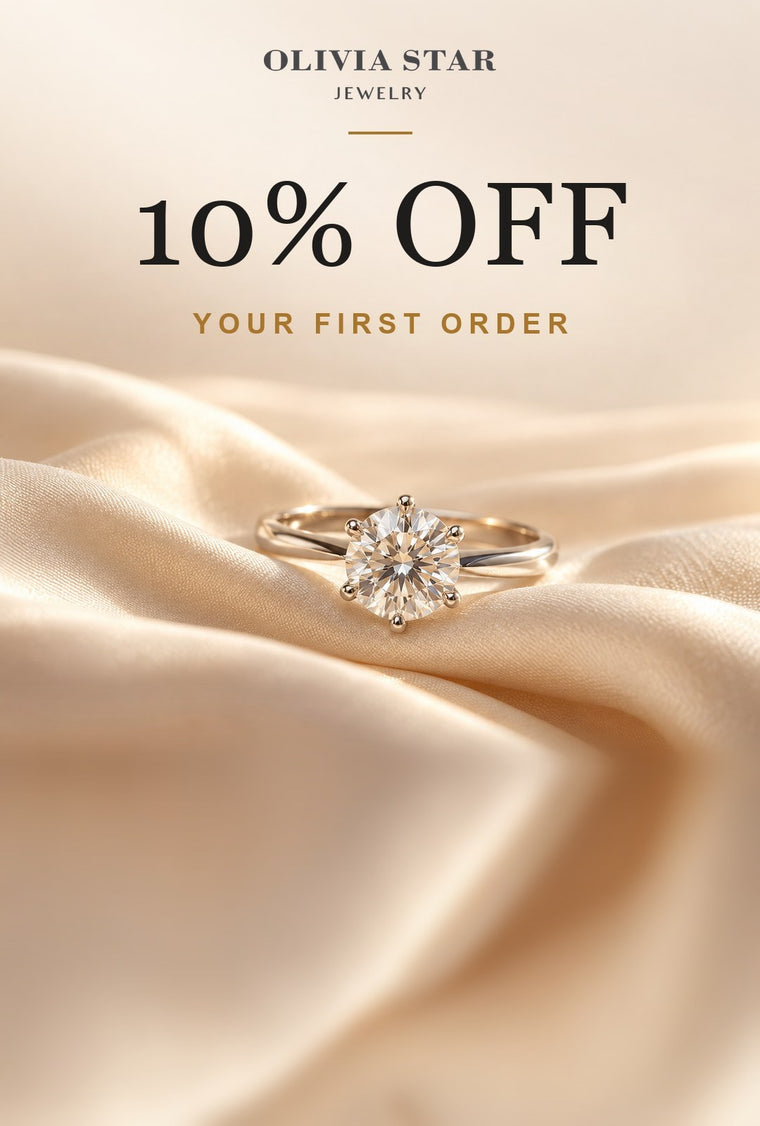
Moissanite started as a mystery in a meteorite crater and ended up as one of the most brilliant stones you can wear. Here is the whole path, from a French chemist's microscope to the ring on your hand, and what the report in your Olivia Star box actually tells you.
A stone that fell from the sky
About 50,000 years ago a meteorite hit the desert in northern Arizona and left a crater more than half a mile wide. Today it is called Meteor Crater, and fragments of that meteorite are known as Canyon Diablo.

In 1893 the French chemist Henri Moissan was studying pieces of that meteorite and found tiny, very hard, very bright crystals. At first he thought they were diamonds. By 1904 he had shown they were something else: silicon carbide, a compound of silicon and carbon. The mineral was named moissanite in his honor. Two years later Moissan received the Nobel Prize in Chemistry, for a different discovery.

There was one problem. In nature moissanite is extraordinarily rare, and the grains are microscopic. You could not cut a jewelry stone from what the earth provides. Every moissanite in jewelry today, ours included, is grown in a laboratory.
From industry to jewelry
People had actually made silicon carbide before Moissan's find. In 1891 the American inventor Edward Acheson produced it while experimenting at high temperature and called it carborundum. For a century it was an industrial material: dark, opaque crystals used for grinding wheels and sandpaper, because they are almost as hard as diamond.

Growing it clear enough to be a gem took decades of research. The technique was refined in the 1990s, and the first moissanite gemstones reached the jewelry market in 1998. The same crystal-growing know-how is used today to make silicon carbide wafers for the power chips in electric cars.

How a moissanite is made, step by step

- The raw material. Growing starts with a very pure silicon carbide source material.
- Heat. In a sealed chamber it is heated past 2,000°C (about 3,600°F) until it turns into vapor.
- Growth. The vapor settles on a small seed crystal and builds up, layer on layer, into a larger crystal. This takes weeks, and the temperature has to stay under close control the whole time: any wobble shows up as color or inclusions.
- Slicing. The finished crystal is sliced into blocks, and each block is shaped into a rough stone close to its final size.
- Cutting and polishing. A cutter places the facets one by one, 57 of them on a round brilliant, and polishes each one. Moissanite is hard, 9.25 on the Mohs scale, so this is slow work.
- Grading. Every stone is checked for color, clarity and cut, and the results go on a report.
Why moissanite sparkles the way it does
Two numbers explain most of it. The first is the refractive index, how strongly a stone bends light: 2.65 to 2.69 for moissanite, 2.42 for diamond. More bending means more light comes back to your eye as brilliance. The second is dispersion, how much a stone splits white light into colors: 0.104 for moissanite, 0.044 for diamond. That is where the rainbow flashes come from, and why moissanite looks especially lively in sunlight and candlelight.
One honest note: moissanite is doubly refractive. In some cuts, looking at an angle, you may see facet edges slightly doubled. Round stones are oriented during cutting to keep this out of view from the top.
Moissanite, lab diamond and mined diamond
People often compare these three, so here they are side by side.
| Moissanite | Lab-grown diamond | Mined diamond | |
|---|---|---|---|
| What it is | Silicon carbide | Carbon | Carbon |
| Where it comes from | Grown in a lab | Grown in a lab (HPHT or CVD) | Mined |
| Hardness (Mohs) | 9.25 | 10 | 10 |
| Brilliance (refractive index) | 2.65 to 2.69 | 2.42 | 2.42 |
| Fire (dispersion) | 0.104 | 0.044 | 0.044 |
| Weight for the same size | About 10% lighter | Same as mined | Reference |
| Price | A fraction of a diamond | Less than mined | Highest |
Because moissanite is lighter, we list our stones in DEW, diamond equivalent weight: a 1.0 ct DEW moissanite is 6.5 mm across, the size of a one carat round diamond. The millimeters are shown on every product page.
What the GRA report in your box tells you


Most moissanite on the market ships with a GRA report, a specification card from the moissanite trade. It lists:
- Report number. Unique to the stone.
- Shape and measurements. For example, round brilliant, 5.0 mm.
- Carat weight. In diamond equivalent weight.
- Color. Our stones are graded D, the top of the colorless scale.
- Clarity. Ours are VVS1: any inclusions are so small that a trained grader has trouble finding them under 10x magnification.
- Cut, polish and symmetry. Graded from Excellent down.
- Inscription. If the report lists one, the same number is laser-written on the thin edge of the stone. You need a 10x loupe to see it.
Keep the report with your piece: it records the size, color and clarity your stone was sold as.
One thing worth knowing: GRA is not an accredited lab like GIA or IGI, and the card is not the result of a gemologist examining your particular stone. It records what the stone was sold as; our guide to the GRA report explains what it does and does not prove. To confirm a stone is moissanite, any jeweler with a multi-tester can check it in a minute.
How to care for moissanite
Moissanite does not get cloudy or change color with time. Oil and lotion can dull any stone, though, so give it a rinse now and then: warm water, a drop of mild soap, a soft toothbrush behind the stone, then dry with a lint-free cloth. Our settings are 925 sterling silver, which can darken over time; a silver polishing cloth brings the shine back.
Questions we get
Is moissanite a diamond?
No. It is its own gemstone, silicon carbide, with more fire than a diamond and slightly lower hardness.
Is lab-grown moissanite real?
Yes. It is real silicon carbide, the same material Moissan found in the meteorite. Lab-grown describes where it was made, not what it is.
Will moissanite pass a diamond tester?
A basic heat tester can read it as diamond, because both carry heat well. Jewelers tell them apart with a moissanite tester, which checks electrical conductivity. We describe our stones as moissanite, always.
How hard is moissanite for everyday wear?
At 9.25 on the Mohs scale it is harder than sapphire (9) and much harder than cubic zirconia (about 8), which makes it a practical stone for a ring worn every day.
See it for yourself
Every moissanite piece we sell is set in hallmarked 925 sterling silver and ships with its GRA report.
Moissanite rings · GRA moissanite earrings · Moissanite pendants